In 2015, a company named 7 Road International was registered in Singapore.
In its early years, it was unremarkable. No one would have guessed that ten years later, this company would become a prominent name in NVIDIA's advanced AI chip supply chain.
In 2023, the company was renamed Megaspeed International, and its business focus began to shift toward cloud computing and AI infrastructure.
Subsequently, its business expanded rapidly.
According to disclosed trade records, from May 2024 to February 2026, Megaspeed-related business imported NVIDIA products worth $4.13 billion. In November 2025 alone, the company imported 17,454 GB300 units, worth approximately $787 million.
A company with a gaming business background suddenly became an important player in AI chip trading.
But this business soon attracted investigation.
In June 2025, U.S. Department of Commerce investigators entered Megaspeed's business site in Singapore. Singapore police also intervened in the investigation, and then-CEO Huang Le had his passport detained and was later banned from re-entering Singapore.
More notably, a discrepancy of approximately 50,000 chips appeared between the chip inventory data NVIDIA provided to the U.S. government and external trade records.
Why could a previously unremarkable company become a multi-billion-dollar AI infrastructure player in a short period of time? And why did it become entangled in an investigation spanning the United States, Singapore, and Malaysia?
The answer lies in an emerging business.
I. GPUs Are in Short Supply, and Compute Intermediaries Have Arrived
What the AI boom changed first was the way GPUs are allocated.
When tech companies around the world are all competing for NVIDIA chips, intermediaries with procurement channels, capital, and data center resources began to find new business opportunities.
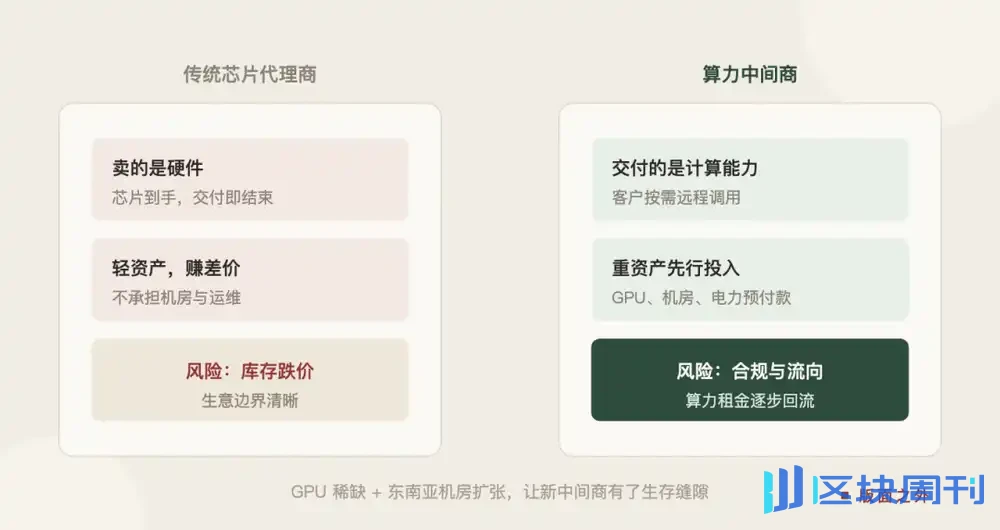
What Megaspeed does is turn chips into rentable compute. It purchases complete GPU servers from NVIDIA and its server partners, then deploys the servers in data centers in places such as Malaysia, connects them to cloud platforms, and rents computing power to customers worldwide.
Customers do not need to buy servers themselves, nor do they need to build computer rooms. As long as they connect through the network, they can use GPUs on demand.
This differs in an important way from traditional chip distributors: distributors sell hardware, while compute intermediaries deliver computing power.
A GPU starts from NVIDIA's supply chain, passes through server manufacturers and traders, enters a data center, and ultimately becomes compute that can be called from the cloud. What the intermediary earns is the spread between hardware procurement, infrastructure deployment, and compute services, as well as the premium generated by integrating scarce resources.
This business can exist thanks to two forces.
On one side, global GPU supply falls short of demand. Demand for large-model training and inference is growing rapidly, and tech companies, startups, and research institutions are all looking for compute. Companies that can obtain chips and deliver quickly have a chance to win orders.
On the other side is the expansion of data centers in Southeast Asia.
Singapore is a regional data center and financial hub, but land, power, and energy consumption limits put pressure on new projects. Malaysia, which borders Singapore, especially Johor State, has relatively abundant land and power resources and has gradually taken on data center investment.
Thus, a new division of labor took shape: chips are procured from the global supply chain, servers are deployed in Southeast Asia, and compute is delivered through the network to customers in different countries.
This has also caused a certain separation between chips and compute.
The physical location of a GPU can be in Malaysia, while the customer using it may be far away in another country. Customers do not need to bring the chips to their side; as long as they can remotely access the data center, they can obtain computing power.
Remote invocation itself is not illegal. The key lies in who the end user is, what purpose it is used for, and whether the specific service arrangement complies with export control requirements.
But in an era of GPU scarcity, the ability to connect resources across different regions itself has commercial value.
Megaspeed firmly seized this opportunity.
II. Malaysia Supports a Multi-Billion-Dollar Business
Megaspeed's expansion almost kept pace with the takeoff of Malaysia's data center industry.
The company was formerly connected to the game manufacturer 7 Road International and mainly engaged in overseas game publishing and operations. After its rename in 2023, it began to shift toward cloud computing and AI infrastructure and entered NVIDIA's Cloud Partner (NCP) system.
The speed of transformation was quite astonishing.
According to financial materials disclosed by Reuters, Megaspeed's asset scale grew from about $32.9 million in 2023 to nearly $3 billion in 2024, an increase of nearly 90 times; revenue in 2024 reached $294 million.
However, expansion in scale does not mean the business is already profitable. The company posted an after-tax loss of about $20 million in 2024.
This is not hard to understand.
The compute business is an asset-heavy business. GPU procurement, data center leasing, prepaid electricity, and equipment deployment all require large amounts of capital to be invested upfront. After servers begin operating, they must also continuously bear depreciation and financing costs. Only as compute rental revenue gradually flows back does the early investment have a chance to turn into profit.
Megaspeed needs to continuously procure chips, build compute resources, and then find customers to absorb capacity. The faster it grows, the greater its capital needs.
Its procurement scale is equally astonishing.
According to statistics compiled by Bloomberg based on Malaysian and Indonesian customs records, as of the end of November 2025, NVIDIA hardware imported by Megaspeed and its affiliated companies reached at least $4.6 billion, involving about 136,000 GPUs.
To support this business, Megaspeed built a complex network of affiliated companies in Southeast Asia, with different entities participating in procurement, customs clearance, and business operations respectively.
Then the question follows: after such a large number of chips enter Southeast Asia, where exactly are they deployed, and who uses them?
The Malaysian government has begun tightening its management of the flow of high-performance chips.
On July 14, 2025, Malaysia's Ministry of Investment, Trade and Industry announced that the export, transshipment and transit of U.S.-origin high-performance AI chips require a strategic trade license.
This does not prohibit companies from importing and deploying chips in Malaysia. The regulatory focus is on whether the chips, after entering the country, will continue to flow to other destinations.

Malaysia's appeal lies not only in land and electricity. It also offers a special condition: chips can be deployed locally, while computing power can serve other markets through the network.
In March 2025, The Wall Street Journal reported a rather unusual case.
Four engineers flew to Malaysia, each carrying 15 hard drives, totaling about 80TB of training data. They did not transmit the data abroad over the network; instead, they brought the hard drives directly to a local data center and then rented servers to complete model training.
The data takes a plane, the computing power stays in the server room, and the trained model parameters are sent back.
This incident has no known direct connection to Megaspeed, but it reveals a new demand that Southeast Asian data centers are taking on: customers do not necessarily need to own chips; as long as they can obtain computing power locally, they can complete remote computing tasks.
And for regulators, the questions are becoming more and more specific.
For a company like Megaspeed, the business requires chips to enter Malaysia smoothly, and also requires computing power to be continuously delivered to overseas customers.
The local government has begun asking where the chips go next, which means this supply chain is no longer just about procurement, deployment and leasing.
III. 50,000 Chips Lift the Veil on Supply Chain Doubts
On June 24, 2025, Megaspeed's troubles erupted in concentrated fashion.
Investigators from the U.S. Department of Commerce's Bureau of Industry and Security (BIS) came to the company's business site in Singapore to conduct an end-use check and questioned then-CEO Huang Le.
On almost the same day, Singapore police also began questioning her and detained her passport.
The two groups of investigators were not focused on exactly the same matters.
The U.S. Department of Commerce was concerned about whether advanced chips had flowed to restricted end users, while the Singapore police were investigating whether there had been false declarations in the server procurement process and whether the equipment had been shipped to places other than the declared destinations.
One company, one batch of servers, two investigative perspectives.
Singapore is an important hub for entrepot trade and fund settlement; servers can be purchased and settled here, and then shipped to Malaysia. For investigators, the key question is: where exactly did the equipment go? Is the declared final destination the place where it is actually used?
The Singapore police also sought assistance from the U.S. Department of Justice and the FBI on multiple occasions, hoping that U.S. server supplier Supermicro would cooperate with the investigation, but the assistance obtained was limited.
The investigation did not end quickly.
In February 2026, Singapore police concluded that the evidence was insufficient to find that Huang Le was involved in the server declaration crimes previously investigated. But the police also determined that during the investigation she provided information she knew to be inaccurate, attempting to downplay her role at Megaspeed.
Ultimately, the Singapore authorities issued her a stern warning and banned her from entering the country again.
This does not mean Megaspeed has been found to have broken the law. The investigation into the company and six other related individuals is still ongoing.
Huang Le's experience is only part of this turmoil. What truly made the investigation complicated was another set of numbers.
After comparing trade records and Nvidia inventory data, Bloomberg found that the number of chips Nvidia sold to Megaspeed through hardware partners may be about 50,000 fewer than the number it reported to the U.S. government.
Nvidia offered another explanation: the company additionally checked Megaspeed's other warehouses and found a batch of equipment that had not previously been included in the statistics, but it did not disclose the specific quantity.
Therefore, the gap of 50,000 does not equal missing chips, nor can it directly lead to the conclusion of smuggling. But this number is enough to show that tracking the advanced chip supply chain is not simple.
A GPU may start from the manufacturer and pass through server vendors, traders, affiliated companies and third-party hosting data centers. Inventory records, customs data and actual deployment at different stages may not correspond in real time.
And 50,000 GPUs are already enough to support several large computing centers.
The Megaspeed investigation, therefore, is no longer just a matter of one company's procurement and declarations.
In the summer of 2025, Nvidia's legal chief Tim Teter called U.S. Department of Commerce Deputy Under Secretary for Export Administration Jeffrey Kessler to ask whether BIS had participated in Singapore's investigation of Huang Le.
After that, internal BIS communications and information requests concerning Nvidia were subject to additional restrictions, and some matters were transferred to Kessler for handling. This change sparked questions from Congress and political circles.
In November of the same year, Axios also disclosed that U.S. Treasury Secretary Bessent had questioned Commerce Secretary Lutnick at a White House meeting about why Megaspeed had not yet been placed on the Entity List.
The report also said that the Treasury Department, the Department of Defense, the State Department and the U.S. Trade Representative's Office had previously supported taking restrictive measures against it.
A chip business has begun to affect the interests and judgments of different departments within the U.S. government.
Nvidia needs the global market and needs to expand chip sales as much as possible, while the U.S. government hopes that advanced computing power will not flow to restricted users and regions.
The former cares about commercial scale, the latter cares about technology flows.
Megaspeed happens to stand at the intersection of the two.
IV. The Good Days of Computing Power Arbitrage Are Over
Megaspeed's business model actually depends most on a kind of separation: where chips are deployed is where computing power is generated, but who ultimately uses that computing power can cross borders through cloud services.
This arrangement once left a great deal of operating room for computing power intermediaries.
But now, regulators are beginning to track not only the chips themselves, but also the computing capability the chips provide.
On November 16 this year, the U.S. Department of Commerce's Bureau of Industry and Security published an interim final rule (IFR) targeting remote access to advanced chips, extending the scope of regulation to remote access to advanced computing capability.
The new rule sets a threshold of 12 million TPP for advanced computing capability, roughly equivalent to the computing power of 750 H100 or H200 chips. Data centers that meet the relevant conditions may need to obtain a U.S. export license if they provide remote computing power services to enterprises in certain restricted regions. Providing access through third-party intermediaries is also taken into regulatory consideration.
The rule also involves license requirements for the export, re-export, and transfer of advanced chips in places including Malaysia, Singapore, Indonesia, Thailand, and Brazil.
This change has struck the most important link in the computing power intermediary business.

In the past, enterprises could build data centers in third countries and then rent computing power to overseas customers through cloud services. But today, the physical location of chips is no longer the sole basis for determining compliance; remote access users and end uses have also entered the scope of review.
Of course, this does not mean all cross-border cloud services are prohibited. Whether a license is required still depends on the computing capability threshold, the region, the end user, and the specific access behavior.
But for Megaspeed, the difficulty of doing business has already changed.
It not only has to find GPUs, server rooms, and customers, but also has to figure out who each batch of computing power is ultimately delivered to, whether a license is required, and whether customers' remote access complies with regulatory requirements.
Global customers that could once be connected through the cloud may now become a compliance responsibility that must be verified one by one.
For the same data center and the same batch of GPUs, whether they can continue to be rented out no longer depends only on whether there are customers, but also on who the customers are.
In November 2026, the Malaysian government announced an investigation into whether chips imported by Megaspeed affiliate Speedmatrix were re-exported, and emphasized that previous routine inspections of data centers did not mean the government had issued a compliance endorsement for Megaspeed. The U.S. Department of Commerce and the Department of Justice also confirmed that the investigation into Megaspeed is continuing.
From a company with a gaming business background, to an AI computing power player whose assets swelled nearly 90-fold within a year, and then to being surrounded by supply cuts, investigations, and regulatory rules, Megaspeed has experienced almost the most complete rise and fall of a global computing power arbitrage cycle.
It caught the window of the GPU shortage, and also caught the window of data center expansion in Southeast Asia. However, as regulators begin to track remote access, the final destination of chips is becoming increasingly important, and this distance is no longer just a business opportunity.

Megaspeed has not yet waited for the final conclusion of the investigation, but the growth logic this company relies on has already suffered a dimensional strike.
The intermediary model that survives on information gaps and regulatory loopholes has thus reached the end of the gray zone.
The gold rush era of computing power intermediaries is over.
A word from [Beyond the Page]:
The most fascinating thing about a boom is that it makes people mistakenly believe growth can continue forever.
Megaspeed turned the chip shortage into a business, but failed to free this business from the constraints of external rules.
In the AI era, the scarcest resource may not only be computing power, but also the power to decide where computing power flows.
This article is from the WeChat public account: Beyond the Page , author: Huahua